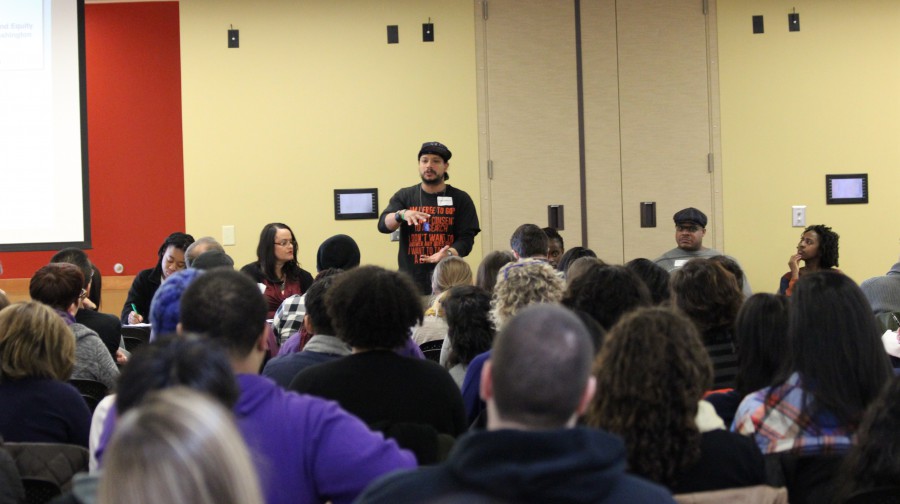
The theme of this year’s Teach-In organized by the Center for Communication, Difference and Equity in partnership with Kelly Ethnic Cultural Center was #BlackLivesMatter. Created by three queer Black women in response to disproportionate police brutality towards Black Americans, #BlackLivesMatter has become an encompassing activism movement to address the racial issues and inequality that persist in our society today. The call to action to all the participants was to become proactive in our cause to protect Black lives.
Opening remarks given by Professor Stephanie Smallwood emphasized the imperative for racial justice activism. She also reminded us that the space given was for a collaborative learning, one that we do not often have the opportunity to experience in a university setting. Here, there was no hierarchy between professors and students, seasoned activists and newcomers, or any dimensions of difference. We were all here to contribute what we could and learn from one another. Her last part prefaced Professor Andrea Otanez’s live Tweeting 101 lesson. Professor Smallwood discussed the importance of documenting what we were doing. In using the Twitter platform, and sharing our thoughts and experiences during the Teach-in, we were able to contribute to the narrative of ideas being exchanged. That way, we were able to bring people who would have wanted but were not able to attend into the conversation. One of our connections was with the Black Prisoner’s Caucus, and while one of their liaisons was in attendance, obviously not everyone else could be there to experience it firsthand.
Professor Otanez then gave the audience a quick rundown of how to live Tweet and use hashtags. Since we had hashtagged all of our Tweets with #BLMTeachIn, a quick search for the hashtag on Twitter allows one to receive information about what was being talked about at the event. The collaboration of users all sharing their personal accounts of the event created a community of racial justice activists on Twitter.
From there, the audience was presented with three starting point questions to get the conversation started: 1) What’s on your mind? 2) What does #BlackLivesMatter mean to you? And 3) What does activism mean to you? While each person let these questions resonate within them, a panel of activists shared their thoughts. Each panelist’s response covered a different aspect of the movement as summarized below:
The first panelist spoke about how media portrayal of racial justice activism has been damaging to our cause. 1960’s Civil Rights movement has been misremembered in a way that allows for critique of what we are doing today. It has been sanitized in the media as much more peaceful than it was, that the battle has already been won, and that it was won with nonviolence and civil disobedience. The first panelist wanted to push back on that narrative, to create space for our own.
The next panelist focused on Black feminism and re-centering the movement around all Black lives. She brought up the issue of the lack of attention non-cis-male Black lives received. Specifically, she addressed Black trans women, who are disproportionate victims of hate crimes and have especially high suicide rates.
The following panelist brought up the role of the media again. This time it was around the representations of African Americans in the media, but specifically in terms of claims of “New Blackness” and a post-racial society. For example, there are celebrities that hurt the movement by using their exposure to support and play into that hegemonic identity of a post racial society rather than being a voice for #BlackLivesMatter and acknowledging the issues that still plague our society.
Another panelist argued that the racial double standard deployed through language dehumanizes the #BlackLivesMatter movement. For example, when a Black person is portrayed in the media as committing a crime, they are often framed as a “thug” whereas a White person is excused as “mentally ill.” This not only hurts us in the dimension of race, but unfairly misrepresenting mental illness as well. There is also stigmatizing language such as “Black on Black crime” even though “White on White” and “White on Black” crime occur at rates that are at least comparable.
The next message was that activism is a way of life and that we do what we do because we have to. We have to because not everyone can put their bodies on the front line and, those who can, do it for those who cannot. The system affects the way we think and interferes with the way that we interact with one another. That is why it must be addressed and properly reworked.
The final panelist discussed the systemized education system. Math proficiency has been implemented as a gatekeeper to education and it is Eurocentric in the way that it is taught. If students are not able perform as dictated by set standards, then students are held back. Added to inequitable ways in which math is taught, Black students are not given the same treatment in classrooms when they misbehave, so they often fall further behind their White counterpart.
Following the panelists’ discussion was audience feedback and dialogue with the panelists until lunchtime, where we broke out to continue the conversation over lunch. The audience questions began with inquiring into the official UW agenda in addressing racial inequity on campus and dialogue on race. Others in the audience addressed specific questions to the panelists regarding issues such as the teaching of history and addressing racial issues on a trans-national scale.
Throughout the bigger discussions around race that I have been a part of in the past months, a prevalent question in my mind has been, “How can we move beyond talking about race to creating change?” I presented this question during our lunchtime discussion. The main answer was that these discussions create opportunities to continue to reach people who may not have been aware of these ideas and we need to continue to get people onto our side. But it was the conversation that spun from that that was the biggest takeaway for me. These discussions are about creating something that will outlast us, because it isn’t just about us and what we are doing. What we are doing is limited by our lifetime but if we can create a legacy to leave behind, then that work can continue on. I then asked what is the best way to go about racial justice and activism, another issue that has been plaguing me. The response was that everything may be problematic on some facet but it is not a matter of whether we are doing enough or doing it in the absolute best way, but that we are doing something. And we can ask those who criticize us, what are they doing?
My lunch discussion reinvigorated the inspiration within me and reminded me the importance of the relationships that we have along this journey. When we have strong mentors in our lives, they can help us answer these questions and keep us on track. The purpose of this teach-in was to renew our commitments to be proactive advocates for Black lives and, at the very least, in me, it has accomplished that purpose.