
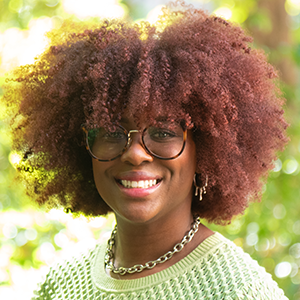
Savaughn Williams

Savaughn Williams

Associate Director

Savaughn Williams is an assistant professor in the Department of Communication at the University of Washington. She received her Ph. D. from the University of Kansas, her received her M.A. from Ball State University, and her B.A. from Oklahoma Baptist University.

Dr. Williams specializes in interpersonal communication, focusing on relationships such as friendships, families, organizational interactions, and more. Her research utilizes critical qualitative methods such as interviews, photovoice, ethnography, and autoethnography to better understand questions around identity, race, and relationships. Dr. Williams utilizes an interdisciplinary approach to theory through utilizing communication theories and critical theories to help explore and better understand underrepresented populations. Through her work, she has explored interracial friendships, families in a nonprofit, Black women in academia, and Black, Indigenous, People of Color (BIPOC) veterans with PTSD. Dr. Williams is most interested in highlighting underrepresented identities and community engagement that makes a difference.
Research Program

Exploring Identity Relationally

Exploring Identity Relationally (EIR) is a research program that works to better understand how we engage identity through interpersonal communication. Hecht (1993) frames identity and communication as one in the same. Every day we make decisions on how to show up in the world, and we communicate these decisions to ourselves, friends, family, and community. In this research program, we will engage identity in a variety of ways through critical qualitative methods. Utilizing critical qualitative methods allows us, as researchers, to better understand how power influences the lived experiences of underrepresented communities. Currently, Defining Blackness through Family Communication is underway to explore how Blackness, as an identity framing, is understood and communicated within Black Families. This study is utilizing an arts-based critical qualitative method called Photovoice to explore how Blackness is communicated visually and verbally.

Research Projects

Defining Blackness through Family Communication

Recent Publications

Peer-Reviewed Journal Articles

  • Williams, S.E., Gist-Mackey, A. N., & Jewell, A. (2023). Colorblind on the color line: Critical ethnography of racial inequity in a human service organization serving a community of families at the margins. Human Communication Research, 1-12. https://doi.org/10.1093/hcr/hqad014
  • Brewer, M., Williams, S.E., & Wilson, M. (2022) Black women in academia. Women in the Academy, 30(2) 25-50. https://online.pubhtml5.com/nsco/hchw/#p=30

Published Book Chapters

  • Williams, S.E. (2023). Say his name and pray it’s not your loved one. S. Symons-LeBlanc, & S. O’Shay (Ed.) 2nd edition of Casing the Family: Theoretical and Applicable Advances in Family Communication. Kendall Hunt
  • Mapes, M., Williams, S.E., Brewer, M. (2023) Feminist grief. In P. English-Schneider & D. Randall-Griffiths (Eds) Narrative and Grief: Autoethnographies of Loss. Lexington.
  • Gist-Mackey, A. N., Williams, S.E., Jewel, A. (2023) Whitewashing the walls: Leading Organizational change from cultures of mistrust to celebrating sisterhood. In B. Van Gilder, J. Austin, & J. Bishop (2023). Communication and Organizational Changemaking: Diversity, Equity, & Inclusion. Routledge.
  • Williams S.E. (2022). Sexuality in my reality: An autoethnography on a Black woman’s sexual journey. In Blithe, S. & Bauer, J. (Ed), Badass feminist politics: Exploring radical edges of feminist theory, communication, and activism.
  • Denker, K. J., Rausch, K., & Williams, S.E. (2020). Learning through the process: Failure, frustration and forward movement in autoethnography. In Herrmann, A. (Ed.), The Routledge International Handbook of Organizational Autoethnography.
  • Williams, S.E., & Denker, K. J. (2019). I get it from my Mama: Doing race, doing gender. S. Symons-LeBlanc (Ed.). Going Behind Closed Doors: Case Studies in Family Communication.

Education

  • B.A., Oklahoma Baptist University
  • M.A., Ball State University
  • PhD, University of Kansas